Thurn and Taxis postal service
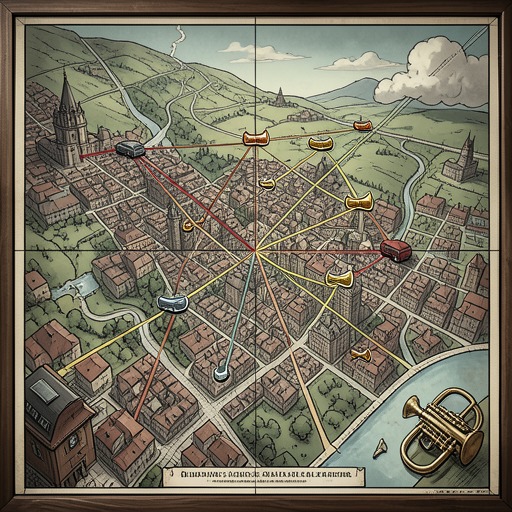
The Crying of Lot 49The Thurn and Taxis postal service is a private European courier system that held a postal monopoly across much of the Holy Roman Empire and, in the novel’s layered history, becomes both a formidable communications authority and the opponent against which the clandestine Tristero defines itself. Its reach, recognizable post-horn emblem, and eventual displacement make it more than a historical reference: it supplies the institutional background against which the book’s secret routes, altered symbols, and uncertain histories gather meaning.
Nature and Historical Reach
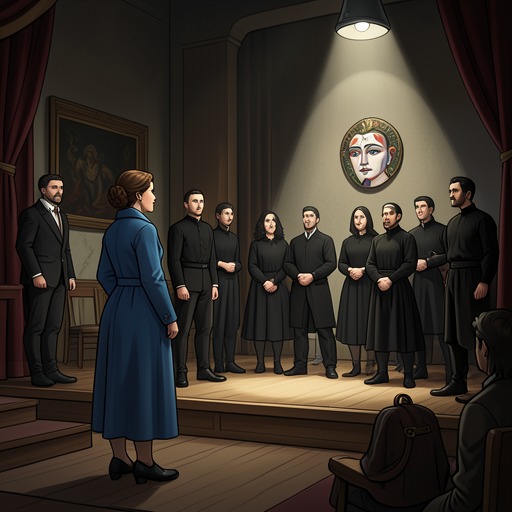
In the embedded play, the service is presented as an established European postal power. Niccolò arrives at the court of Squamuglia masquerading as one of its special couriers. The ostensible purpose is to develop a market: although the Thurn and Taxis system offers lower rates and faster service, the Duke of Squamuglia refuses to use it to communicate with his ally Pasquale in neighboring Faggio, relying instead on his own messengers. Niccolò’s commercial explanation conceals his real purpose of getting close to Duke Angelo, the ruler who had murdered Niccolò’s father.
The organization’s historical span is made explicit when Genghis Cohen identifies one of its stamps. He explains that the service operated from about 1300 until Bismarck bought it out in 1867, and describes it as the European mail service. The stamp is one of its few adhesive issues: an old German example marked “Freimarke,” “Thurn und Taxis,” and the denomination ¼. Its small, repeated post horns connect the institution’s practical identity as a carrier to the emblematic role its symbol will play in Oedipa’s investigation.
The Postal Monopoly and Its Opponents
The play places the service amid struggles over political allegiance and control of communication. Niccolò rides under Thurn and Taxis colors even while his ambitions and loyalties point elsewhere. When a spy reports that he is on his way, Gennaro interrupts the celebration to remind the others that Niccolò is still traveling under those colors. The warning cools the scene: the courier’s association with a powerful postal house makes his position politically ambiguous, even as he appears to be returning to restore Faggio.
Oedipa’s early sense of a wider pattern is shaped by Mike Fallopian’s research into private mail delivery in the United States. Fallopian is trying to connect the Civil War with postal reform beginning around 1845. He regards it as more than coincidence that in 1861 the federal government vigorously suppressed independent routes surviving earlier postal acts, which had been designed to drive private competition into financial ruin. His research gives the history of courier services a political dimension: control of mail can be read as an instrument of institutional power, not merely a technical matter of delivery.
That American history parallels, without simply duplicating, the European conflict. As Oedipa later understands it, Tristero had opposed Thurn and Taxis in Europe before appearing in America, where it contended with other mail carriers and survived as a clandestine channel. The opposition supplies a historical through-line for her accumulating clues, but the account remains part of an unresolved mystery rather than independent proof that every apparent connection belongs to one continuous organization.
The Post Horn and the Tristero Mystery
Cohen’s stamp examination gives the emblem its decisive narrative function. He handles the stamp with tweezers, uses benzine and a black tray, and illuminates it so Oedipa can inspect the watermark through a magnifying glass. The mark resembles the symbol she has already encountered: a post horn with a single loop in each corner of the Thurn and Taxis stamp. Oedipa recalls the play’s image of a “gold once-knotted horn” and compares the watermark’s extra projection to a mute. Cohen cautiously guesses that the mark represents a muted horn. The inference links the altered symbol to an effort to silence or oppose the established postal emblem, but the characters do not yet possess a complete account of who made the mark or how it was used.
The play makes that inference resonate. At its ending, Gennaro names Trystero in lines that join the postal house’s horn to the threat of a secret appointment with its adversary. The word remains suspended at the act’s close, puzzling Oedipa before it acquires further force through her investigations. The scene does not settle the history; instead, the play’s dramatic revelation becomes one of the materials through which she tries to interpret the signs outside the theater.
The symbol recurs across otherwise disparate evidence. Oedipa encounters it in a watermark, notices a resemblance to the mark associated with the Tristero, and later learns that Tristero’s emblem is understood as a muted post horn. A separate account of the mark’s discovery describes gasoline dissolving the printing ink on stamps, revealing the watermark beneath. These recurrences make the Thurn and Taxis device a durable clue: it can persist beneath an apparently ordinary printed surface, while a small alteration transforms a familiar emblem into a sign of resistance.
Displacement, Adaptation, and Significance
The novel’s retrospective account of Tristero’s survival presents the postal service as one side of a continuing contest over communication. In Europe, Tristero had opposed the Thurn and Taxis system; in America, it adapted to a new field of competition and political pressure. As Oedipa’s accumulated understanding has it, the underground network’s messengers could operate in disguise, and its emphasis shifted toward silence, impersonation, and opposition concealed beneath apparent allegiance. The Thurn and Taxis service therefore anchors a history in which a communications monopoly can be challenged not only by open rivals but by routes that hide their identity and purpose.
The service’s historical termination in 1867 contrasts with the uncertain persistence attributed to Tristero. Its stamps and horn offer Oedipa concrete objects to compare, but the evidence never removes her central doubt over whether the connections form a real organization or a pattern she has imposed on coincidences. Thurn and Taxis thus serves both as a specific postal institution and as the visible standard against which the muted horn acquires its meaning: a mark of communication turned against the system whose own emblem it alters.